
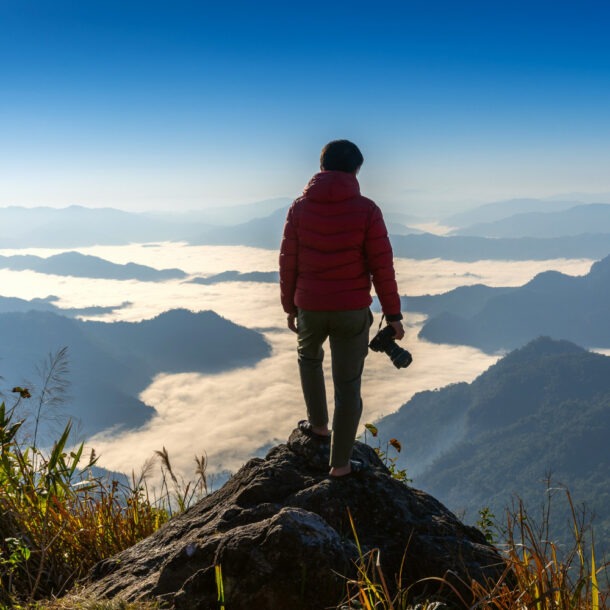


Lamahatta has mild summers, a heavy monsoon and cold, mostly dry winters. Going by the India Meteorological Department’s 1991–2020 normals for nearby Darjeeling, days peak at about 19–20 °C from May to October and drop to about 11 °C in January, when nights fall close to freezing. For clear Himalayan views and dry trails, the best time to visit Lamahatta is October to early December, followed by March to May. June to September brings most of the year’s rain.
Below you will find the month-by-month figures, what each season feels like at our retreat opposite the Lamahatta Eco Park, the snowfall picture, and a packing list.
Lamahatta has no weather station of its own, so nobody publishes official climate averages for the village. The nearest long-running station is Darjeeling, which the IMD lists at 2,128 m above sea level in its Climatological Tables 1991–2020. Lamahatta is about 22–23 km away by road and lower, at around 5,700 ft (about 1,740 m). Outlook Traveller and eSamskriti give the same height.
That puts the village roughly 390 m below the Darjeeling station. Meteorologists use a standard rate of about 6.5 °C of cooling for every kilometre of height. San Diego State University’s explainer on the standard atmosphere points out that this is an idealised average and that the real atmosphere “varies with the weather”. As a rough guide only, Lamahatta may therefore run a couple of degrees milder than the Darjeeling figures. Wind, cloud and the exposure of a ridge can easily cancel that out, so treat the table as a close guide, not a forecast.
All temperature and rainfall figures are 1991–2020 normals for the Darjeeling station, from the IMD Climatological Tables 1991–2020. “Rainy days” there means days with 2.5 mm of rain or more.
| Month | Avg max °C | Avg min °C | Rainfall mm | What to expect |
|---|---|---|---|---|
| January | 11.1 | 1.7 | 10.8 | The coldest month. Crisp, mostly dry days (about 1 rainy day), with nights near freezing. |
| February | 12.4 | 3.1 | 11.4 | Still cold and largely dry. In some years the higher ridges around Darjeeling get a dusting of snow. |
| March | 15.9 | 6.0 | 26.4 | Warming up, with occasional showers. Afternoons get hazier as spring goes on. |
| April | 18.6 | 9.0 | 89.0 | Pleasant days and cool nights. Pre-monsoon showers start, with about 7 rainy days. |
| May | 19.3 | 10.8 | 160.3 | Mild but wetter (about 10 rainy days), with more cloud in the afternoons. |
| June | 19.8 | 12.8 | 419.1 | The monsoon sets in. About 18 rainy days, plenty of mist and green forest. |
| July | 19.5 | 13.4 | 648.5 | The wettest month (about 23 rainy days). Mountain views are rare. |
| August | 19.9 | 13.5 | 529.8 | Still very wet (about 22 rainy days), with warm, humid nights by hill standards. |
| September | 19.5 | 12.7 | 385.2 | Rain eases late in the month, though there are still about 16 rainy days. |
| October | 19.4 | 9.9 | 78.8 | Skies clear as the monsoon withdraws (about 4 rainy days). Comfortable days for walking. |
| November | 17.2 | 6.2 | 11.2 | Dry and clear (under 1 rainy day), with cold mornings and evenings. |
| December | 13.7 | 3.5 | 2.8 | The driest month. Cold, sharp air and long, clear evenings. |
Across the year, the Darjeeling station averages a 17.3 °C daily maximum, an 8.8 °C daily minimum, 2,373.3 mm of rain and about 106 rainy days. June to September alone accounts for about 1,983 mm, or roughly 84% of the annual total. December to February together average only about 25 mm. The extremes in the same IMD tables run from −7.2 °C to 28.5 °C, so very cold nights and warm afternoons do happen. They are just not typical.
It depends on what you come for:
Spring warms quickly. Average maximums rise from 15.9 °C in March to 19.3 °C in May, and minimums from 6.0 °C to 10.8 °C (IMD). Mornings are usually the clearest part of the day, so plan viewpoints and the walk up through the pine forest to the Pokhri (lake) at the top of the Eco Park for early in the day. Rain picks up through the season, from 26.4 mm in March to 160.3 mm in May, so carry a light rain layer by late April.
The monsoon is the defining feature of the Darjeeling hills’ climate. July alone averages 648.5 mm at the Darjeeling station, and June to September brings about 17–23 rainy days a month (IMD). Temperatures stay mild, at about 13 °C at night and 20 °C by day. The forest of pine and Dhupi (cypress) turns deep green, and cloud often drifts through the village.
Heavy rain can also disrupt hill roads. In early October 2025, as the monsoon was ending, PTI reported in The Week that more than 300 mm of rain in about 12 hours set off landslides across the Darjeeling hills. At least 20 people were killed, Mirik was the worst affected, and many roads were blocked. If you travel in the rains, keep your plans flexible, start drives early in the day, and check road and weather updates before you set out. Our team can share the latest local conditions when you call.
After the monsoon withdraws, rainfall drops sharply, from 385.2 mm in September to 78.8 mm in October and just 11.2 mm in November. Rainy days fall from about 16 to about 4 and then to under one (IMD). Days are still comfortable at 17–19 °C, while nights cool to about 6 °C by November. This is the season to aim for if your main goal is a clear view of the Kanchenjunga range. Our rooms have large windows, and the Juniper and Pine rooms on the first floor face the Kanchenjunga range across the pine forest.
From December to February, Lamahatta is cold and mostly dry. The Darjeeling normals give maximums of 11–14 °C and minimums of 1.7–3.5 °C, and December averages just 2.8 mm of rain (IMD). Outlook Traveller puts it simply: “Winters, especially after sunset, can be very cold.” In practice, Lamahatta in December means bright, sharp days that suit walks and day trips, then early evenings indoors. Our rooms have 24/7 hot water, an electric kettle and tea/coffee makers, and room rates include breakfast and dinner for two adults.
Snow is uncommon at this height, and we know of no published record of snowfall in Lamahatta itself. What the sources do show is that the higher ridges around Darjeeling get snow in some winters:
If seeing snow is the main reason for your trip, treat it as a bonus rather than a promise. Come between late December and February and keep an eye on the forecast. A cold snap can bring snow to the Tiger Hill and Ghoom ridges, which are a short drive away.
Because Lamahatta has no station, the most reliable official reading is the IMD forecast and observations for Darjeeling. You can find them on the IMD website and through its Regional Meteorological Centre, Kolkata, which covers West Bengal. Expect conditions at the village to be close to Darjeeling’s, often slightly milder. For a quick local check on cloud, mist or road conditions before you leave, call or WhatsApp our team on +91 93823 42597 or +91 93308 34776.
Long-term trends are worth knowing too. A 2024 peer-reviewed study in Atmosphere analysed Darjeeling data for 1991–2023 and found statistically significant upward trends in rainfall and in both maximum and minimum temperatures. An earlier study in the Indian Forester (2006) found that rainy days had fallen sharply at some sites in the Darjeeling Himalayas. Year-to-year weather can therefore differ noticeably from the 30-year averages above.
For ideas on how to spend your days in any season, from the Eco Park and village walk to day trips to Darjeeling, Kalimpong, Tinchuley and Takdah, see our things to do in Lamahatta page.
Mild to cool for most of the year. Using the IMD 1991–2020 normals for nearby Darjeeling, average maximums range from 11.1 °C in January to 19.9 °C in August, and minimums from 1.7 °C to 13.5 °C. About 84% of the yearly rain falls between June and September.
October to early December is the clearest and driest stretch for Kanchenjunga views. March to May offers mild days and spring flowers. June to September is the wettest period, so expect mist and possible road disruption.
About 5,700 ft (roughly 1,740 m), according to Outlook Traveller and eSamskriti. That is a little lower than the 2,128 m Darjeeling weather station, about 22–23 km away by road.
Snow is uncommon, and we have found no published record of snowfall in Lamahatta itself. Higher points nearby, such as Tiger Hill, Ghoom and Jorebungalow, have had snow in some winters (for example February 2020 and December 2021). Sandakphu, Bengal’s highest point, had its first snowfall of the 2024–25 season in November 2024.
The Darjeeling normals for December are a 13.7 °C average maximum and a 3.5 °C average minimum, with only 2.8 mm of rain. Days are usually clear and nights are cold, so pack warm layers.
Many people do visit, but heavy rain can trigger landslides and block hill roads, as it did across the Darjeeling hills in October 2025. Keep your plans flexible, travel in daylight, and check IMD updates and local road conditions before you set out.